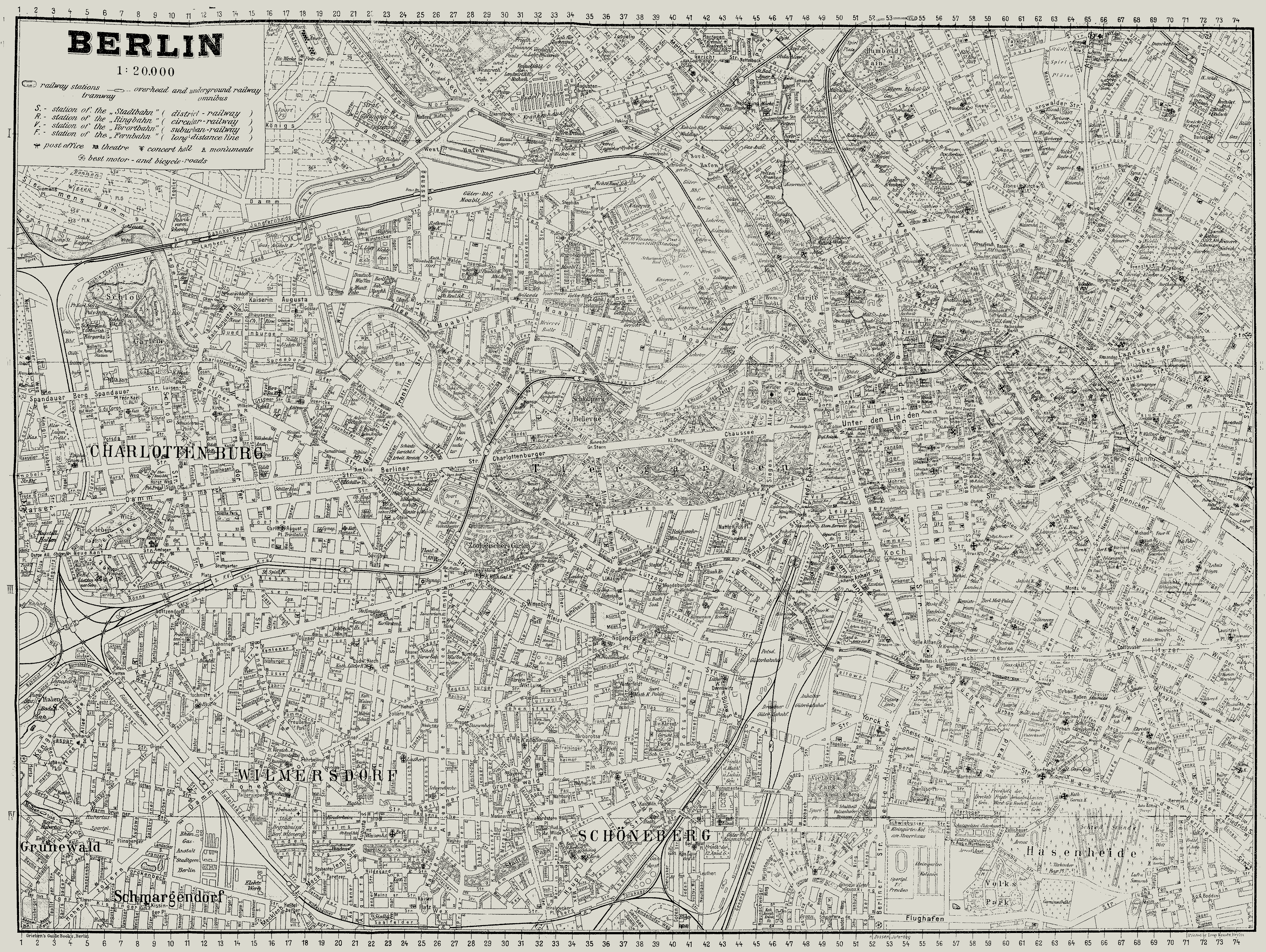
The Irish playwright, novelist and poet Samuel Beckett (1906–1989) is perhaps most readily associated with the city of Berlin through the Schiller Theater, Charlottenburg, where he directed or co-directed several of his own plays during the 1960s and 70s. Some three decades earlier, however, the young Beckett had already spent an extended period of the time in the city, stopping over in Berlin for six weeks as part of a tour of Germany, which took him from Hamburg to Munich between September 1936 and April 1937.
Upon his arrival in Berlin in December 1936, Beckett briefly lodged at the Hotel Deutsche Traube on Invalidenstraße before relocating to a pension on Budapeststraße, near the Zoological Gardens. Armed with a Grieben guidebook, he methodically explored the city’s sights and museums, avoiding the bustle of the Christmas Market in the Lustgarten and spending his evenings at the Romanisches Café, the cinema or the theatre. While he pronounced the new films released by the large German production companies Ufa and Tobis ‘indescribably bad,’ his visits to the theatre provided ample food for thought. 1 A performance of Hebbel’s blank verse tragedy Gyges und sein Ring at the Schauspielhaus on Gendarmenmarkt inspired a long entry in Beckett’s travel diary in which the future author of Waiting for Godot muses on the relationship between poetry and action in drama. The ‘poetical play’, he notes there, ‘can never come off as play, nor when played as poetry either, because the words obscure the action and are obscured by it’. 2
Berlin’s art collections were another major draw for Beckett and his travel diaries contain a meticulous account of more than twenty museum visits during his stay. Besides the Kaiser-Friedrich-Museum (now Bode Museum) and the Deutsches Museum, where he admired the collections of Italian, Dutch and German Old Masters, he also visited the Nationalgalerie, the Pergamonmuseum and a private collection of Subarean monumental sculpture at the Tell-Halaf-Museum (destroyed in 1943) in Charlottenburg. The last of these provided him with a suitable metaphor when, in relaying his first impressions of Berlin to the German bookseller Günter Albrecht, he described the city as ‘eine geschwätzige Sphinx […], die ausser der Inkonsequenz ihrer Erscheinung kein Rätsel aufzugeben hat’ [‘a talkative sphinx […], posing no riddle besides the inconsequence of her appearance’]. 3
Yet, the image the young Beckett draws of 1930s Berlin in his diaries and correspondence is coloured not only by the city’s rich cultural offerings but also by a sense of unease and revulsion at the palpable impact of Nazism on German public life. For the tourist Beckett, the effects of the Hitler regime’s repressive cultural politics became most immediately apparent in the closure of an entire floor of the Kronprinzenpalais, where he had hoped to see the Nationalgalerie’s collection of modern European painting. A sore disappointment, although, as he wrote to Thomas MacGreevey, he was still able to see some ‘wonderful Munchs & Van Goghs’. 4
Between the martial headlines of Der Angriff, the Nazi’s official Berlin newspaper, and his landlord’s ardent praise for Hitler, Beckett’s stay in Berlin was punctuated by moments of intense alienation. It was only when he was introduced to the young bookseller Axel Kaun that he finally felt able to have a frank discussion on politics and literature. Kaun, who later worked for the publisher Rowohlt, is now known above all as the recipient of Beckett’s famous ‘German letter’ from July 1937, in which the Irish writer exhorts the necessity of rending the ‘Schleier’ [‘veil’] of the English language, ‘um an die dahinter liegenden Dinge (oder das dahinter liegende Nichts) zu kommen’ [‘to get at the things (or nothings) hidden behind it’]. 5
Beckett left Berlin towards the end of January 1937, travelling on to Dresden via Halle, Weimar, Naumburg and Leipzig. He would return sixteen years later, in September 1953, when Wir warten auf Godot [Waiting for Godot] celebrated its German premiere at the Schloßpark-Theater, Berlin-Steglitz, in the Western section of a divided capital. Evi Heinz
1— Beckett to Mary Manning Howe, 18 January 1937, The Letters of Samuel Beckett. Volume 1, 1929–1940, ed. by Martha Dow Fehsenfeld and Lois More Overbeck (Cambridge: Cambridge University Press, 2009), p. 423.
2— Quoted in James Knowlson, Damned to Fame: The Life of Samuel Beckett (London: Bloomsbury, 1996), p. 246.
3— Samuel Beckett to Günter Albrecht, 31 December 1936, The Letters of Samuel Beckett, p. 409.
4— Samuel Beckett to Thomas MacGreevey, 22 December 1936, ibid. p. 402.
5— Samuel Beckett to Axel Kaun, 9 July 1937, ibid. pp. 513–14.
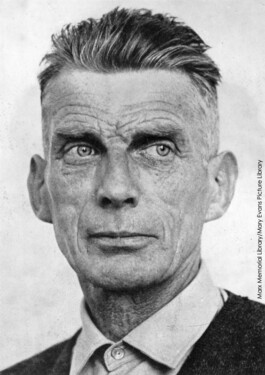
Samuel Beckett, German Diaries, ed. by Mark Nixon and Oliver Lubrich with translations by Gaby Hartel, forthcoming with Suhrkamp in 2026
The Letters of Samuel Beckett. Volume 1, 1929–1940, ed. by Martha Dow Fehsenfeld and Lois More Overbeck (Cambridge: Cambridge University Press, 2009)
James Knowlson, Damned to Fame: The Life of Samuel Beckett (London: Bloomsbury, 1996), pp. 230–261
Mark Nixon, Samuel Beckett’s German Diaries, 1936–1937 (London: Continuum, 2011)
Erika Tophoven, Becketts Berlin (Berlin: Nicolai, 2005)