Margaret Goldsmith was born in Milwaukee (USA) to German migrant parents but grew up in Berlin. After studying German in America during the First World War she worked as an economic advisor for the American Embassy in Berlin, and later turned to journalism, translation, and fiction, possibly encouraged by the prominent American journalist Dorothy Thompson whom she met in Berlin. For a time, Goldsmith was married to the Berlin correspondent of the Manchester Guardian, Frederick Augustus Voigt, a Briton of German descent (1926–35). Although they later divorced, not much is known about this relationship except that they collaborated on book projects, and seemingly continued to be on comparatively friendly terms. The marriage may of course have been a mariage blanc or a lavender marriage. A character who strongly resembles Voigt physically in Goldsmith’s novel Belated Adventure might be interpreted as her former husband, hinting at sexual repression due to a strict puritan upbringing, but that is speculative at best.
Portraits of Goldsmith are rare, but the best-known one was taken by Lucia Moholy-Nagy, a photographer related to the Bauhaus group of artists, a fact which illustrates Goldsmith’s connections to Weimar Berlin’s art scene. The portrait focuses on the wild hair and expressive eyes in similar fashion to the one we have been able to include here, which has been reproduced from a review of Goldsmith’s non-fiction book Seven Women Against the World (1935). The review was published in the periodical Britannia and Eve. Goldsmith’s connections to the Berlin art world extended to the graphic artist and painter Martel Schwichtenberg, with whom she may also have had an affair, and to whom the novel Patience geht vorüber (1931) was dedicated. Martel Schwichtenberg is also included in Goldsmith’s roman à clef Belated Adventure (1929), which furthermore features a thinly-veiled Vita Sackville-West (as Hester Drummond).
Goldsmith and Sackville-West met during Harold Nicolson’s tenure as deputy chief of mission at the British Embassy in Berlin, and accounts exist of the two couples becoming friends. Sackville-West intervened on Goldsmith’s behalf, who had tried to become Virginia Woolf’s German translator and agent for Germany. The plan ultimately failed as Woolf was already contracted to Fischer Verlag. Sackville-West writes of Goldsmith: ‘She is extremely nice, and energetic and intelligent; and incidentally a bosom friend of mine. Though I would not recommend her if I was not sure that you would do well by her.’ 1
Woolf however was not in favour, and complained jealously about Goldsmith’s ‘American’ brashness and ‘vulgarity’, details one can learn from Woolf’s letter to Sackville-West. 2
Goldsmith’s comments on the Bloomsbury group – couched in fictional terms in her Berlin novels – are equally scathing. She lets her alter ego Bernice muse jealously on what Goldsmith/Bernice perceives to be their limitations:
Most of the literary people, who lived near her in Bloomsbury, appealed to her but little; always she was more interested in life than she was in literature. Sometimes, with Hester, she went to a Bloomsbury party, but the rarefied atmosphere, which seemed to permeate these gatherings, was almost distasteful to her. She felt somehow that most of these people whom she met at these parties were getting at life through literature, particularly through each other’s books. 3
‘Parlour-adventurers, she had once called them, parlour-adventurers, who sit about analysing their emotions, picking them to pieces and then putting the pieces together again into patterns, which, she did admit, were sometimes lovely, and these patterns were their books. The relationship with Sackville-West, which led to a collaborative translation of Rilke’s Duino Elegies, published in 1931 without mentioning Goldsmith’s name, is echoed in some of Goldsmith’s literary fiction, most notably in Belated Adventure and Patience geht vorüber but it ended quite soon after it had begun, because Sackville-West tired of it, much to Goldsmith’s regret.
Goldsmith’s career as a writer is firmly associated both with Weimar Berlin and Bloomsbury London. The rise of fascism in Germany led her to move to London, where she would spend the rest of her life, and to switch entirely and exclusively to English as the language in which she published. Apart from what one can gather from her wide-ranging non-fictional works, biographical facts are quite elusive, but she seems to have spent her life with the librarian of the Athenaeum Club, Eileen Stiff, and become intensely interested in both lesbian and feminist issues. Her three novels Karin’s Mother (1928), Belated Adventure, and Patience geht vorüber are particularly illuminating in a Berlin context, as they focus on Weimar Berlin, queer love, female emancipation, Anglo-German relations, Prussianism versus British pragmatism, and the rise of the labour movement and the November Revolution, following the end of the First World War. Strong feminist and openly lesbian plots serve as an interesting counterpart to the more oblique discourse on female desire which the British literary field imposed upon writers following the prohibition in 1928 of the much less explicit novel The Well of Loneliness by Radclyffe Hall.
Das Erwecken der Sinnlichkeit hatte Grete stark verändert. Sie lebte wie in einem Rausch. Jetzt war sie es, die von beiden – wenigstens äußerlich – die Abhängigere war. (…) Patience (fuhr) fort: „Und weißt du, so mit uns. Du weißt schon, was ich meine … da hab’ ich auch so das schwebende Gefühl. Ich möchte ein Mann sein. Dein Mann… Du, ich laß mir übrigens morgen die Haare schneiden … ach, ich kann dir alles so schwer erklären…“ „Sei nicht traurig“, sagte Grete, „und nimm nicht alles so furchtbar ernst.“ Plötzlich umarmte sie Patience und diese vergaß alles andere. 4
In terms of her political orientation, Goldsmith was decidedly anti-fascist. Her knowledge of the rise of the National Socialist Party may have helped her friend, the writer Katherine Burdekin, develop the plot of the work of counterfactual, dystopian fiction which imagines a future Britain under the rule of a Hitleresque dictator. The novel Swastika Night (1937) was published under Burdekin’s pseudonym Murray Constantine. Goldsmith helped to connect exiled German writers to the London publishing scene during the 1930s and translated numerous works into English, e.g. Aufstand der Fischer von St. Barbara by Anna Seghers and Zwischenfall in Lohwinkel by Vicki Baum. She also translated the seminal Berlin-based children’s novel Emil und die Detektive by Erich Kästner (originally published in 1929, translated 1931) – a novel whose film adaptation by Billy Wilder inspired Benjamin Britten and came to encompass Weimar Berlin for many viewers.
Goldsmith’s works of fiction are currently being republished by the feminist Berlin publishing house Aviva, and scholarly interest in her varied body of work is increasing. Gesa Stedman, with additional research by Evelina Bazaeva
1—Virginia Woolf in a letter to Vita Sackville West, 14 March 1928. DeSalvo, Louise and Mitchell A. Leaska (eds), The Letters of Vita Sackville-West and Virginia Woolf (New York: William Morrow & Co., 1985), p. 262.
2— Virginia Woolf to Vita Sackville-West, 27 April 1928. Nicolson, Ben and Joanne Trautmann (eds), The Letters of Virginia Woolf (New York: Harcourt, Brace, Jovanovich, 1975–80), vol. III, pp. 487–88.
3— Belated Adventure, pp. 77–78.
4— Patience geht vorüber, p. 52. ‘The awakening of her sensuality hat changed Grete profoundly. She lived as if in a frenzy. It was now she – at least as far as one could observe – who was the more dependent. (…) Patience continued: “You know, us, the two of us – you know what I mean – I have this floating feeling. I want to be a man. Your husband. I say – I am going to have my hair cut tomorrow … oh, I just can’t explain it to you properly…” “Don’t be sad”, said Grete, “and don’t take everything so desperately seriously.” She suddenly hugged Patience and Patience forgot everything else.’ (translated by Gesa Stedman)
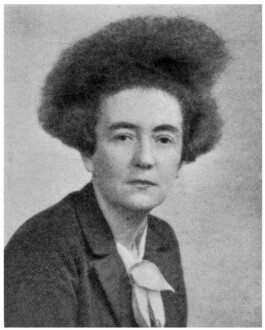
Margaret Goldsmith, © Illustrated London News Ltd. / Mary Evans
Goldsmith, Margaret, Karin’s Mother (New York: Payson & Clarke, 1928)
Goldsmith, Margaret, Belated Adventure (London: Jonathan Cape, 1929)
Goldsmith, Margaret, Patience geht vorüber (Berlin: Aviva, 2022) (original: Berlin: Kindt & Buchner Verlag, 1931)
DeSalvo, Louise and Mitchell A. Leaska (eds), The Letters of Vita Sackville-West and Virginia Woolf (New York: William Morrow & Co., 1985)
Nicolson, Ben and Joanne Trautmann (eds), The Letters of Virginia Woolf (New York: Harcourt, Brace, Jovanovich, 1975–80)
English, Elizabeth, ‘Imaginative Biography: Margaret Goldsmith, Vita Sackville-West and Lesbian Historical Life Writing’, in Interrogating Lesbian Modernism. Histories, Forms, Genres, ed. by Elizabeth English, Jana Funke, and Sarah Parker (Edinburgh: EUP, 2023), pp. 99–119
Gruber, Eckhard, ‘Paare – Passantinnen. Margaret Goldsmith und ihr Roman “Patience geht vorüber”’, in Margaret Goldsmith, Patience geht vorüber (Berlin: Aviva, 2022), pp. 190-221
Hermanns, Doris, Und alles ist hier fremd. Deutschsprachige Schriftstellerinnen im britischen Exil (Berlin: Aviva, 2022)
N.A. ‘Margeret L. Goldsmith’, https://www.fembio.org/biographie.php/frau/biographie/margaret-l-goldsmith/ last access 14 December 2025